
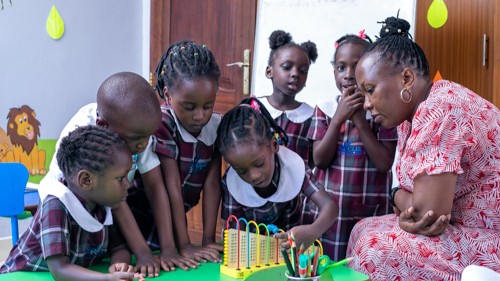
Many schools carry the name “Christian,” and typically begin their day with a 20-minute devotion. After this short moment of spiritual focus, the children move on with their “normal” routines—only to repeat the cycle the next day.
This rhythm, while well-intentioned, raises some sobering questions:
Is this all there is to Christian education? Is 20 minutes a day enough to truly shape a child’s heart for Christ?
As both a mother and an educationist, these questions have weighed heavily on my heart.
Scripture is clear: “Train up a child in the way he should go, and when he is old, he will not depart from it” (Proverbs 22:6). The Bible points us to the power of intentional, consistent training.
Christian education, then, is not merely a title or a brief morning activity. It is a tool—used by both parents and educators—to nurture and transform children into the likeness of Christ.
God, in His infinite wisdom, knows that the shaping of a child’s heart takes time, commitment, and repetition. The question we must ask ourselves is this:
Are our current methods aligning with this divine model of discipleship?
Martin Luther once said, “People must have righteous principles in the first, and then they will not fail to perform virtuous actions.” But how do we instill these righteous principles in children?
The answer lies in more than devotionals—it lies in the very structure of learning itself.
A truly Christian school doesn’t simply add a Bible class or chapel session to the schedule. Instead, it immerses children in a worldview where God is central to every subject:
In Math, they see a God of order, logic, and precision.
In Language, they discover the power of words—used by God to create and reveal. They encounter men and women who daily leave their lives in service to the Lord through the comprehension passages.
In Science, they explore the intricacies of ecosystems, human life, and natural laws—all pointing to an excellent Creator.
In Geography, they marvel at His handiwork across mountains, rivers, and landscapes.
In this model, the curriculum itself becomes a tool of discipleship—not by coercion, but by repeatedly revealing God’s power, wisdom and character through every learning experience.
As children consistently encounter God’s wisdom, beauty, and truth woven into every part of life and learning, they are drawn toward Him. Over time, these seeds of truth take root. And in God’s perfect timing, they blossom into a personal decision to follow Christ.
Christian education is not just about information—it’s about transformation.
It is about raising a generation that not only knows about God but sees the world through His eyes. A generation that recognizes Christ in every subject, every moment and every encounter.
That kind of transformation takes more than 20 minutes a day.
It takes a vision.
It takes a commitment.
It takes a curriculum—and a community—rooted in Christ.